
AV-14 Attack VTOL: Difference between revisions
imported>Thedemonapostle No edit summary |
imported>Thedemonapostle No edit summary |
||
| (6 intermediate revisions by the same user not shown) | |||
| Line 1: | Line 1: | ||
[[File:Hornet.jpg|500px|thumb|right]] | [[File:Hornet.jpg|500px|thumb|right|link=Special:FilePath/Hornet.jpg]] | ||
[[File:AV-14 Hornet.png|thumb|500px|right]] | [[File:AV-14 Hornet.png|thumb|500px|right|link=Special:FilePath/AV-14_Hornet.png]] | ||
[[File:AV-14 Hornet.jpg|thumb|500px|right]] | [[File:AV-14 Hornet.jpg|thumb|500px|right|link=Special:FilePath/AV-14_Hornet.jpg]] | ||
'''Name''': AV-14 Hornet<br />'''Craft''': Misriah Armory AV-14 "Hornet" Attack VTOL<br />'''Type''': Close Air Support / Light Troop Transport / Light Anti-Vehicle<br />'''Scale''': speeder<br />'''Length''': 9.6 x 8.7 meters<br />'''Skill''': repulsorlift operations<br />'''Crew''': 1<br />'''Passengers''': 4<br />'''Cargo Capacity''': 50kg<br />'''Consumables''': 3 days<br />'''Maneuverability''': 2D<br />'''Move''': 55; 160kmh<br />'''Cover''': 1/2<br />'''Hull''': 3D | '''Name''': AV-14 Hornet<br />'''Craft''': Misriah Armory AV-14 "Hornet" Attack VTOL<br />'''Type''': Close Air Support / Light Troop Transport / Light Anti-Vehicle<br />'''Scale''': speeder<br />'''Length''': 9.6 x 8.7 meters<br />'''Skill''': repulsorlift operations<br />'''Crew''': 1<br />'''Passengers''': 4<br />'''Cargo Capacity''': 50kg<br />'''Consumables''': 3 days<br />'''Maneuverability''': 2D+1<br />'''Move''': 55; 160kmh<br />'''Cover''': 1/2<br />'''Hull''': 3D<br />'''Sensors''' | ||
*Passive: | *Passive: 20km / 0D+1 | ||
*Scan: | *Scan: 40km / 1D | ||
*Search: | *Search: 60km / 1D+1 | ||
*Focus: | *Focus: 2km / 2D | ||
'''Weapons''' | '''Weapons''' | ||
*'''2 | *'''2 GUA-23/A Heavy Autocannons''' (firelinked) | ||
: Fire Arc: forward chin turret<br />Crew: 1<br />Scale: walker<br />Skill: vehicle blasters<br />Fire Control: 1D<br />Atmosphere Range: | : Fire Arc: forward chin turret<br />Crew: 1<br />Scale: walker<br />Skill: vehicle blasters<br />Fire Control: 1D<br />Atmosphere Range: 10-300/800/1,500m<br />Damage: 5D+1 | ||
*'''2 | *'''2 Class-2 GMLSs''' | ||
: Fire Arc: forward<br />Crew: 1<br />Scale: | : Fire Arc: forward<br />Crew: 1<br />Scale: walker<br />Skill: missile weapons<br />Fire Control: 2D<br />Atmosphere Range: 10-600/1,500/3,000m<br />Ammo: 8 per launcher<br />Damage: 5D+1 | ||
'''Description''' | '''Description''': The AV-14 Attack VTOL, also known as the Hornet, is a United Nations Space Command assault and reconnaissance aircraft. The Hornet is capable of fulfilling multiple roles from close air support to Special Forces insertion. | ||
The AV-14 Attack VTOL, also known as the Hornet, is a United Nations Space Command assault and reconnaissance aircraft. The Hornet is capable of fulfilling multiple roles from close air support to Special Forces insertion. | |||
The AV-14 is a vertical takeoff and landing aircraft (VTOL) that has been in service since at least 2424 and has played a role in multiple campaigns starting with Operation: TREBUCHET. It serves as the UNSC's Assault, Search, Reconnaissance, and Close Air Support Aircraft. The Hornet is an atmospheric only craft and as such cannot be deployed by orbital vessels unless a ship rated for atmospheric entry can deliver it to the battlefield. It is easier for the Hornet to be deployed from an air base located on the surface than from a ship. | The AV-14 is a vertical takeoff and landing aircraft (VTOL) that has been in service since at least 2424 and has played a role in multiple campaigns starting with Operation: TREBUCHET. It serves as the UNSC's Assault, Search, Reconnaissance, and Close Air Support Aircraft. The Hornet is an atmospheric only craft and as such cannot be deployed by orbital vessels unless a ship rated for atmospheric entry can deliver it to the battlefield. It is easier for the Hornet to be deployed from an air base located on the surface than from a ship. | ||
| Line 23: | Line 21: | ||
Although the AV-14 Hornet primarily serves as an attack craft, like most UNSC hardware it is flexible, able to serve as a multipurpose aircraft, and can be configured for a particular role — variant models include the AV-14 Reconnaissance and the AV-14 Transport and dependent upon mission requirements can be customized accordingly. | Although the AV-14 Hornet primarily serves as an attack craft, like most UNSC hardware it is flexible, able to serve as a multipurpose aircraft, and can be configured for a particular role — variant models include the AV-14 Reconnaissance and the AV-14 Transport and dependent upon mission requirements can be customized accordingly. | ||
'''Source''' | '''Source''' | ||
*[http://halo.wikia.com/wiki/AV-14_Attack_VTOL Halo Wiki: AV-14 Attack VTOL] | *[http://halo.wikia.com/wiki/AV-14_Attack_VTOL Halo Wiki: AV-14 Attack VTOL] | ||
*thedemonapostle | *thedemonapostle | ||
Latest revision as of 20:22, 2 August 2021
Name: AV-14 Hornet
Craft: Misriah Armory AV-14 "Hornet" Attack VTOL
Type: Close Air Support / Light Troop Transport / Light Anti-Vehicle
Scale: speeder
Length: 9.6 x 8.7 meters
Skill: repulsorlift operations
Crew: 1
Passengers: 4
Cargo Capacity: 50kg
Consumables: 3 days
Maneuverability: 2D+1
Move: 55; 160kmh
Cover: 1/2
Hull: 3D
Sensors
- Passive: 20km / 0D+1
- Scan: 40km / 1D
- Search: 60km / 1D+1
- Focus: 2km / 2D
Weapons
- 2 GUA-23/A Heavy Autocannons (firelinked)
- Fire Arc: forward chin turret
Crew: 1
Scale: walker
Skill: vehicle blasters
Fire Control: 1D
Atmosphere Range: 10-300/800/1,500m
Damage: 5D+1
- 2 Class-2 GMLSs
- Fire Arc: forward
Crew: 1
Scale: walker
Skill: missile weapons
Fire Control: 2D
Atmosphere Range: 10-600/1,500/3,000m
Ammo: 8 per launcher
Damage: 5D+1
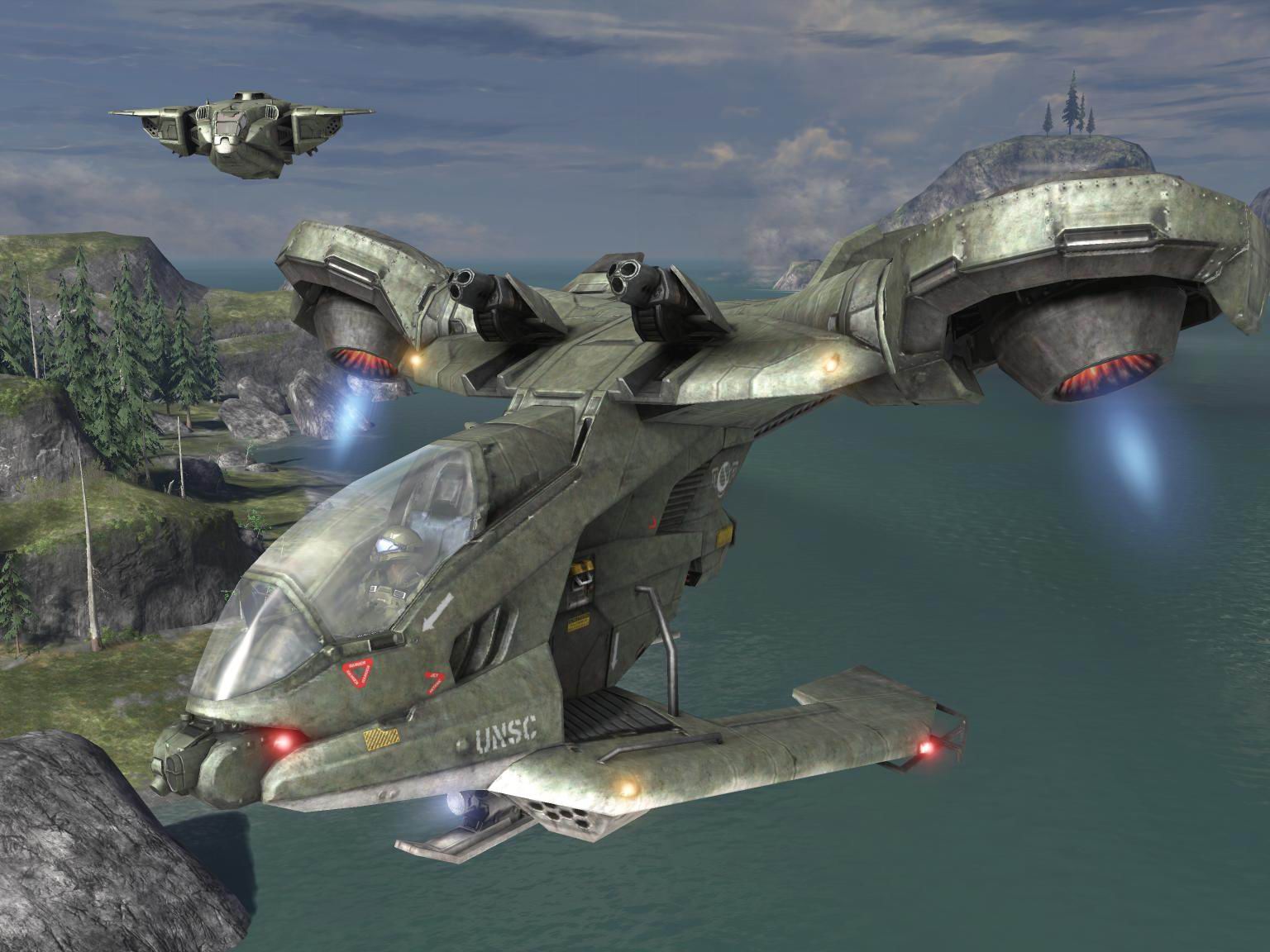
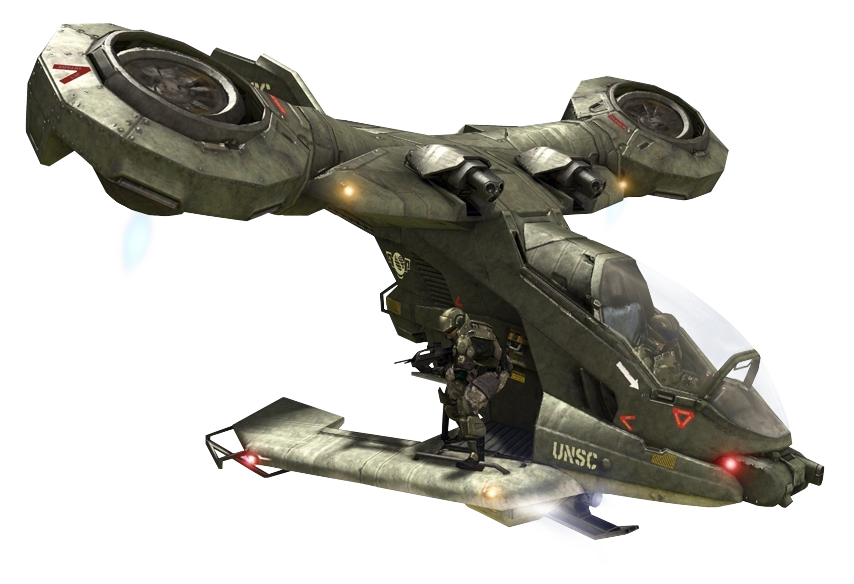
Description: The AV-14 Attack VTOL, also known as the Hornet, is a United Nations Space Command assault and reconnaissance aircraft. The Hornet is capable of fulfilling multiple roles from close air support to Special Forces insertion.
The AV-14 is a vertical takeoff and landing aircraft (VTOL) that has been in service since at least 2424 and has played a role in multiple campaigns starting with Operation: TREBUCHET. It serves as the UNSC's Assault, Search, Reconnaissance, and Close Air Support Aircraft. The Hornet is an atmospheric only craft and as such cannot be deployed by orbital vessels unless a ship rated for atmospheric entry can deliver it to the battlefield. It is easier for the Hornet to be deployed from an air base located on the surface than from a ship.
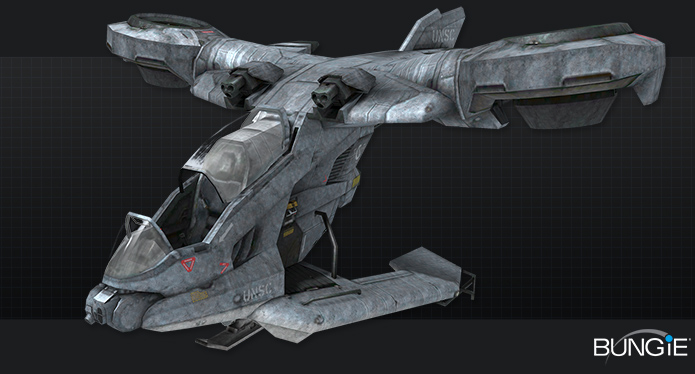
The AV-14 Hornet consists of a one-man cockpit and a rear section, extending approximately one meter backward. Variant models feature a tandem seating configuration, presumably allowing a second passenger to operate the aircraft's weaponry or navigation systems. At the top of this rear section are a set of wings with what appear to be advanced turbofan engines mounted on gimbals at the ends, providing the Hornet's main source of propulsion. The front of the Hornet contains a target acquisition and designation system which includes cameras and sensors. On each side of the cockpit is a jump-seat extending backward that doubles as a landing skid. These skids allow up to four passengers, though the additional weight runs the risk of overloading the aircraft.
Although the AV-14 Hornet primarily serves as an attack craft, like most UNSC hardware it is flexible, able to serve as a multipurpose aircraft, and can be configured for a particular role — variant models include the AV-14 Reconnaissance and the AV-14 Transport and dependent upon mission requirements can be customized accordingly.
Source
- Halo Wiki: AV-14 Attack VTOL
- thedemonapostle